When you are installing heavy glass panels, the last thing you want is the equipment to mess up and make your job harder than it already is. Which means you need a solution that handles the daily glass weight requirement, lifts and moves the glass safely around the worksite, and positions the panels accurately. With vacuum glass lifters and glass lifting robots, workers can now easily handle the glass panels. While that remains true, how do you know which solution to choose? Confused? Then let’s find out.
What Is a Vacuum Glass Lifter?
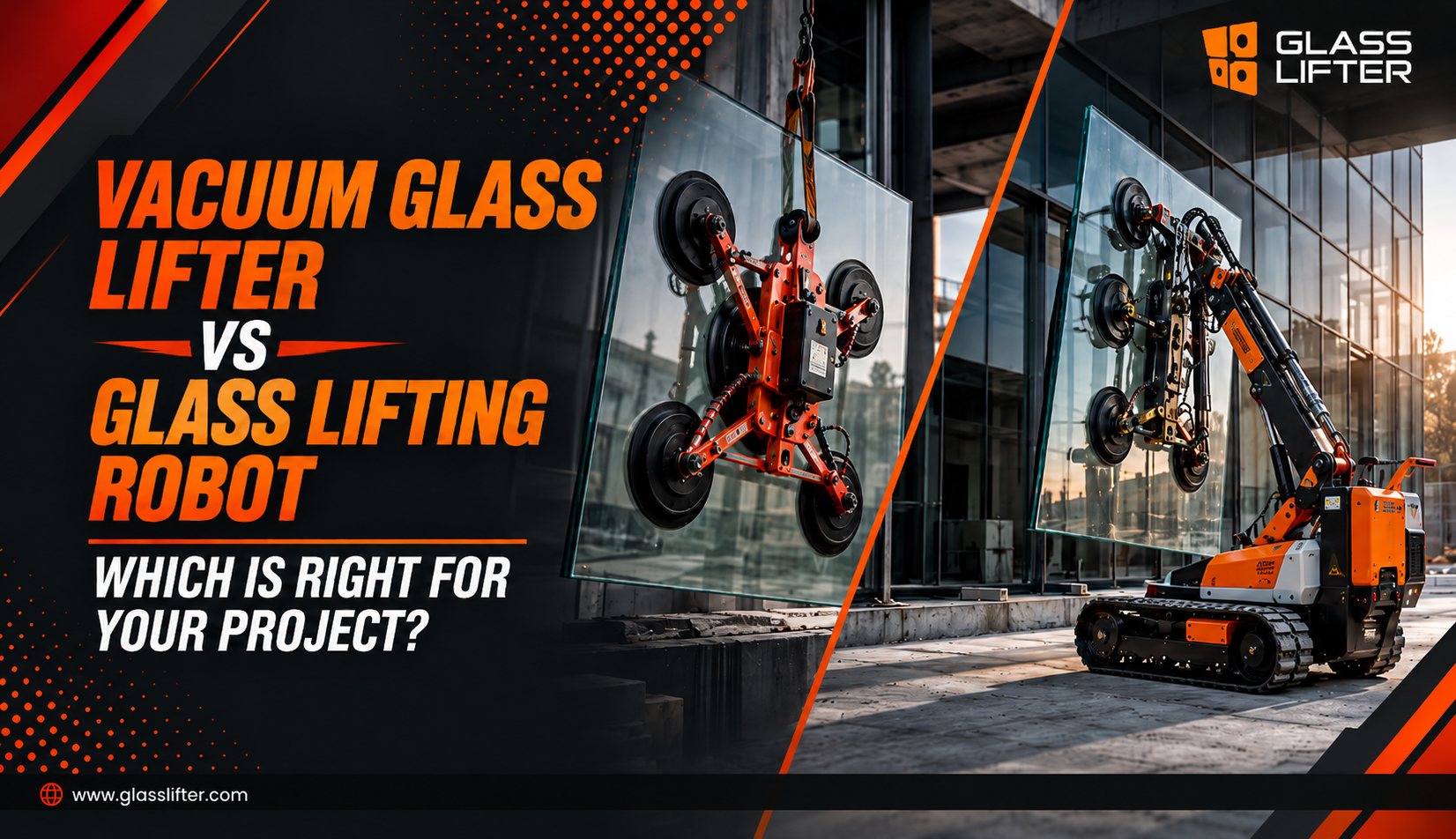
Let’s start with the basics, vacuum glass lifters use suction pads to grip the glass panels. Usually they are attached to a crane, hoist, or other similar lifting equipment, they lift and position the glass panels securely to the designated spot. Glass lifters are a practical option if you need to lift the panel vertically, rotate or tilt it while installing.
Depending on the model the movements may be manual or powered. These are best suited for projects where the glass needs to be lifted into position using a crane or lifting system .
What Is a Glass Lifting Robot?
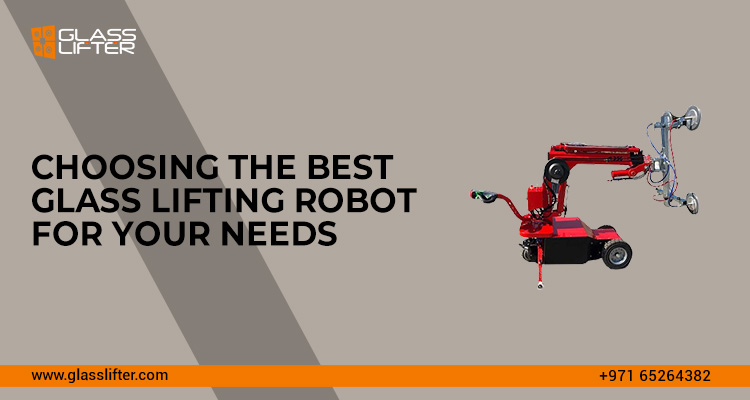
Glass lifting robots do the same except that they can move as well. Yes, they combine a vacuum gripping system with a mobile machine that can lift, transport, and position the glass accordingly. This way operators needn’t rely solely on a crane for movement, because the robot does that part quite clearly and safely.
Vacuum Glasslifter vs Glass Lifting Robot
| Factor | Vacuum Glass Lifter | Glass Lifting Robot |
|---|---|---|
| Glass weight | Depends on the rated capacity of the lifter | Depends on the rated payload of the robot |
| Glass size | Needs proper frame configuration and suction-pad placement | Stable gripping capacity, reach and handling range are a must. |
| Site access | Works with a compatible crane or hoist | Needs enough space for the robot to travel across the worksite. |
| Mobility | It is moved along with the crane or lifting equipment | Travels using its own power |
| Positioning | Rotation and tilting features depend on the model | May provide powered movement and more control while positioning |
| Project | Suited for standard and straightforward lifting operations | More useful for multi-stage installations and at worksites that have challenging access conditions. |
How to Choose Between the Two?
The truth is neither of the two options are automatically better, because the benefit depends entirely on the project requirements. But you can consider these given factors while deciding between the two:
1. Consider the Weight and Sizes of the Glass
First things first, you have to know the weight and dimensions of the glass panels you deal with. For large panels, vacuum glass lifters may be a suitable choice; make sure their rated capacity, suction-pad placement, and compatibility with the lifting system meets the project requirement.
If the glass panels are heavy and on top of that you have to move them across the site and position them in a difficult-to-access location, then a glass lifting robot would be the right choice. Some models feature high lifting capacity and extended reach, helping the operators to position the panels beyond the machine’s floor space.
2. Check Site Access and Available Space
Site conditions are no joke, because that helps you to choose the solution that works best. If the project has a suitable crane or hoist with a defined lifting path, then a glass lifter would be a practical addition. You can enhance the functionality of the existing lifting equipment.
But, then again, if the panel needs to be moved across the site to reach a particular installation point, glass lifting robots are the best. Make sure that the worksite has enough space for the robot to enter, turn and operate safely.
3. Mobility and Positioning
Yeah, positioning the glass panel isn’t easy as it seems. One wrong move, there goes the money, material, and human resource. In the case of a vacuum glass lifter, it handles the gripping and positioning part, while the crane does the main lifting and movement. The rotation and tilting can be either manual or powered depending on the model.
A glass lifter stands out in this context, because it combines these functions. Depending on the model, it can lift and transport the glass panel across the site and provide powered adjustments to rightly align them with the frame or facade.
4. Match the Equipment to the Project Complexity
The picture is so far clear. For a straightforward window replacement and similar projects, a vacuum glass lifter can be the most practical solution.
For commercial facade installation that involves multiple large panels, combined with restricted access and repeated repositioning, a glass lifting robot may help you to get the work done easily.
How Do You Choose the Right Glass Lifting Solution?
Before choosing between the two it is better if you ask these questions yourself, just to be aware of the situation:
- How heavy is the glass panel? So that you check the weight and dimensions of the panels you deal with.
- How high must the glass be lifted? Look into the required work height and reach.
- Is the crane or hoist already available? If you have a lifting system at hand, then a vacuum glass lifter may be a good choice.
- Is the floorspace enough for the task? Consider the access routes, turning space, and ground conditions.
- How precisely should the panel be positioned? This way you can know if it requires manual adjustments or powered movements.
- Will the equipment be used for other projects? A question that you should ask, because you have to consider the future requirements as well.
Conclusion
So, in conclusion, choosing between a vacuum glass lifter and a glass lifting robot narrows down to the site’s access, glass panel dimensions and specifications, lifting requirements, and positioning needs. If you have a lifting system at hand, you can add a vacuum glass lifter to upgrade it’s capacity and functioning. If the project needs the glass panels to be moved and positioned in a challenging access point, the glass lifting robots is the go-to option.
So, need help in choosing the right lifting equipment? That’s what we are here for. At Glass Lifter we provide a smart and advanced glass lifting solution that suits your work site conditions and installation requirements. For more information contact our team and explore our product range.